
In previous chapters on early computing, I explored their establishment in Australia and how they were used in the production of the earliest forms of computer graphic output done here which was largely Data Visualisation. I will now look into the next stages of the production of computer graphics. This is a period immediately following the initial establishment of computing facilities and the training of people who could program the computers to do useful scientific and industrial work for them. Although this period continues the popular idea of the “Giant Brain” as the main view of computing, new technologies are being added and miniaturisation is proceeding so that smaller, desk size (not yet “desk-top”) computers became available. With these “mini-computers” it became possible to dedicate a processor to a more narrow range of functions, for example laboratory data acquisition, and here in particular, to graphic production.
Most of the kind of graphics that we will encounter in this chapter belong to the class of what are known as vector graphics, in which the objects to be drawn in any picture were stored as a list of instructions to draw lines or curves or more complex objects as vectors, at first with a plotter and later on a screen. Each vector had a start and an endpoint and some sort of fixed way of connecting them for example a line drawn between the two points.1
John Bennett and the introduction of Computer Art
In many ways it is John Bennett, originally the Chief Numerical Analyst for the Basser Computing Department of the School of Physics in the University of Sydney and one of the first programmers for SILLIAC, who is responsible for kicking off the computer arts in Australia. He had studied Civil Engineering at the University of Queensland and after attending a course in radiophysics conducted by the School of Physics in the University of Sydney,2 he worked on ground radar for the RAAF during WWII. At the end of the war he pursued further studies in electrical engineering, physics and mathematics, and over the 1945/46 summer vacation he was attached to the Division of Electrotechnology of the CSIRO, which was led by David Myers.3 He also met Trevor Pearcey during this period. In 1946, while working for the then Brisbane City Electric Light Company, he was required to carry out a series of lengthy calculations and realised that the best way to handle this kind of work would be with the new computers being developed in the UK. So he applied for a research student position at the National Physical Laboratories4 in the UK. His application was passed to Douglas Hartree who arranged for him to become Maurice Wilkes’ first research student at the Cambridge University Mathematical Laboratory (Wilkes was the laboratory’s director), and in September 1947 he began his postgraduate studies at Cambridge.5 Wilkes was developing a machine called EDSAC. In his first year there Bennett designed and constructed
“the main control unit (which sequenced the machine through the cycle of extracting from the store and decoding instructions (orders we called them), extracting operands, initiating individual arithmetical and logical processes, and proceeding to the next instruction. [He] also designed, constructed and tested the bootstrap facility.”6

He then went on to develop interpretive programming techniques7 on EDSAC and with that the concept of a library of subroutines.8 In 1950 he moved to the Ferranti company in Manchester, to develop the logical organization of the Ferranti Mark I*.9 In 1955 Bennett was lured back to Australia to become the numerical analyst for the new computing department in the School of Physics and arrived in January 1956,10 commencing duties at what was, by then, the Adolph Basser Computing Laboratory on 2nd February 1956.11 In 1961 Bennett was appointed Professor of Physics (Computing) in the Basser Computing Department of the School of Physics.12 He assisted in the development of the software facilities of the SILLIAC machine and in the teaching of programming to scientists and engineers both within the University of Sydney and in outside industry. [Fig.1] See the SILLIAC site for the detailed story of SILLIAC in the Basser Computing Laboratory.
By 1961, SILLIAC was becoming overloaded with work and a SILLIAC II was mooted, however its development costs became too high and in 1962 it was announced that an English Electric KDF9 would be its replacement. The KDF9 was commissioned in April 1964 by the Governor General Lord De L’Isle and a banner was printed out with the coat of arms of the University, the Governor General’s coat of arms and the announcement of the computer’s thanks. [Fig.2] This kind of ascii-graphics printing used the technique of placing characters in appropriate places on the page so that image density was replicated by the density of pixels used in any character.


Although Bennett spent most of his time in teaching and developing the numerical software capabilities of the department’s machines, he also developed an interest in the artistic possibilities of computers. Computer art was in its early years but the journal Computers and Automation, in the US, had been running an annual computer art competition since 1963. In 1966 Bennett encouraged his research assistant, Phil Cooley, to enter a computer art competition in which the winner would receive “some free computer time on a time-shared system”.13 Cooley had gained a Diploma in Automatic Computing in the Basser Department in 1966 and, after not taking up an offer of a PhD position, had become Bennett’s research assistant, working at Basser for nearly two years over 1966-68. He worked on the CDC-1700 writing some of its time-sharing functions as well as with some of the astronomers, particularly Don Herbison-Evans, and with Jenny Edwards on mathematical algorithms.14 As Cooley put it: “one of the projects that Bennett gave him was to do some computer artworks for this computer art competition”. Unfortunately he does not recall what the competition was but his entries were based on a series of plotter drawings he programmed.15 Working on the KDF9 he “developed a series of general purpose objects” using the mathematics of a curve known as Pascal’s limacon, of which the cardioid is a special case.16 He could then arrange a selection of up to twenty of these objects on a page, plotting them in different colour pens with different intensities and orientations for a complete image. Learning as he went, he found he could “accurately place small objects with solid colours within larger objects” building “up new objects from the standard object”.17 From his results he selected a few to enter the competition and thinks he may have won one of the prizes though he does say he’s not certain of that.
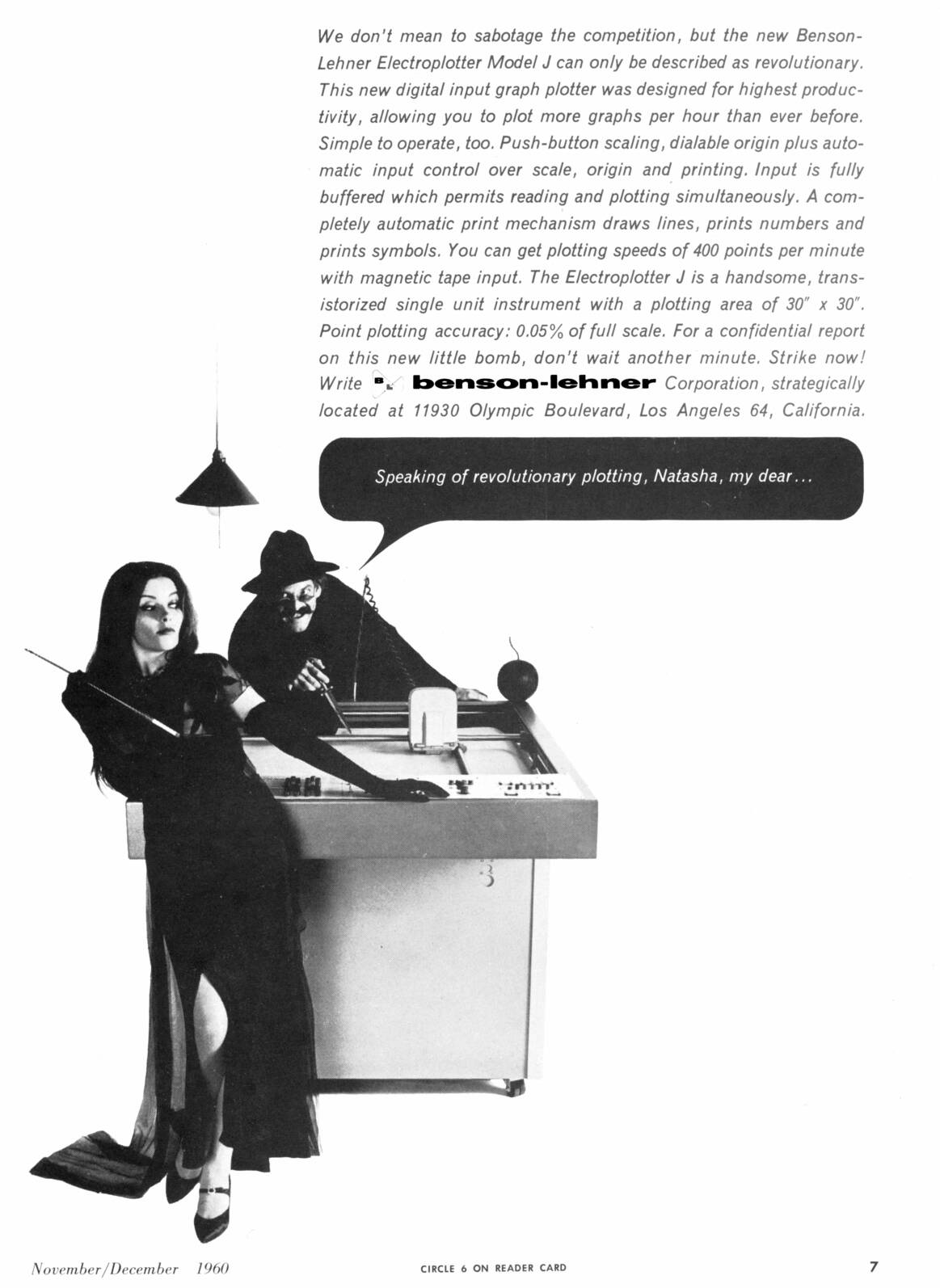
Later, in 1966, the Basser Department purchased a Benson-Lehner drum-plotter18 for its scientific work.
Bennett’s main project over 1967-68, other than the mathematical algorithms that he and his research assistants Phil Cooley and then Jenny Edwards were working on, would have been networking the disparate computers in the Basser Department
The drum-plotter was directly connected to the KDF9 by George Oliphant, and Paul Doman wrote the plotter interface code.19 SILLIAC was retained until 1968. It was simulated on the KDF9 which became the preferred machine to do all the work that had originally been done on SILLIAC. However it turned out that SILLIAC had a much better magnetic tape handling arrangement than the KDF9 so Chris Wallace designed a fast communications link between the two machines which meant that SILLIAC could now be seen by the KDF9 as a peripheral. This was the first step in developing one of the earliest local area networks in the world.20 In 1967 IBM donated an IBM-7040 (for number crunching) with a 1401 front end. This was followed up with a CDC-1700 which was also linked up with the KDF9 to make it remotely accessible from a small time-shared terminals network for use by the scientists. A DEC-PDP8 minicomputer was also purchased to be used as a graphics “workstation” for the KDF9.

Now all the machines were linked up [see Fig.3]. So during a visit to Britain in 1968 Bennett presented a paper (jointly authored with Chris Wallace and J.W. Winings) reporting on this new development and the idea of distributing functions over several processors that allowed the load to be shared across machines with different capabilities at the 1968 International Federation for Information Processing (IFIP 68) conference in Edinburgh, Scotland, held over 5-10 August, 1968.20
It seems likely that while at the conference he heard a paper written by Leslie Mezei21 (an early Canadian developer of computer graphics packages based at the University of Toronto) because he mentions it in a later memo to Doug Richardson.22 He then went on to London where he visited the Cybernetic Serendipity exhibition at the Institute of Contemporary Art (2 August to 20 October, 1968)23 which Donald Brook, having established a link between the Fine Arts Department and the Computing Department early in 1968, had told him about.24
On Bennett’s return to Australia, Donald Brook invited him to give a lecture on the Computer Arts to students in the Department of Fine Arts at Sydney University in 1969. He showed a number of slides of computer works during the lecture which, it is very likely, came from various publications in the Fine Arts Department library. Bennett then gave the lecture to the Australian Computer Society in September 1970. An edited version of the talk was published as “Computers and the Visual Arts” in the Australian Computer Journal of November, 1971. Apart from Brook’s students30 it is probable that among the artists who attended the Fine Arts Department lecture were Bert Flugelman and Guy Warren from the Tin Sheds, as well as the abstract painter David Aspden, the Optronic Kinetics crew (also at the Tin Sheds) and Immants Tillers, who was an architecture student at the time.
Bennett raised a number of aesthetic issues and referred to Clement Greenberg’s 1968 lecture at the Power Institute of Fine Arts31 in this article. Greenberg had dedicated his lecture to the problem constantly implicit in modern art; is it “Good Art”? Does it show the “artistic probity”, that lack of art for sensation’s sake, which, for Greenberg, should be regarded as the guiding principle of all taste in whatever artform is embraced. “The quality of art depends on inspired, felt relations or proportions as on nothing else.”32 In other words it depends on composition and arrangement, however those things may actually manifest in any particular form. Greenberg rails against “newness” or “novelty” for its own sake and asks merely for “rightness of “form””.
“To this extent art remains unchangeable. Its quality will always depend on inspiration, and it will never be able to take effect as art except through quality.”33
But it is the construction of aesthetic taste and the determination of quality through one’s own cultural exposure that brings Greenberg’s position to its knees. As much as history is dependent on the interests and intentions of the authors of historical documents and the historians themselves, so it is with the interpretation and aesthetic judgement of art. What we now regard as tasteful or inspired will be quite different from what satisfied Greenberg’s desires. Nowadays we view much of the early Computer Art with a surprised eye having forgotten, through the intervening years, its inspirations and sources of novelty. As keeps happening, what, to one era was the everyday and simply ephemeral might become, to a later era, the rarest and most interesting of items (and of course this perhaps is something that drives me in this project).
While, in Australia, Modernism was at the peak of its acceptance, with the Greenberg lecture and a major survey exhibition called The Field at the National Gallery of Victoria,34 there was also an active critique of Modernism (promoted by Donald Brook and several members of the Contemporary Art Society in Sydney) developing over the period during which this early computer art was being produced; minimalism, idea art, cybernetic and process art had all been launched, but by no means fulfilled, and computer art belonged partly in these realms and partly in the realms of the experimental. Despite Greenberg’s protestations (while retaining at least his request for inspiration) the new arts often showed considerable quality, even if the idea of quality required new vision.
The productions of computer art at this stage were generally minimal and of either mathematical forms (eg, Michael Noll, Frieder Nake) or, to a lesser extent, minimised line drawings of human forms (Charles Csuri or Leslie Mezei and CTG) and produced either on a plotter, or as line-printer emulations of half-toned images (Ken Knowlton).35 Those of a mathematical nature were usually somewhat formal, but the more interesting and to my mind rather more aesthetically pleasing were those in which a random element had been incorporated “helping” in Mezei’s words “to avoid the monotony of regularly regimented spacing of images.”36 However computer art was not well received among the critics of the day, it being largely ignored, something which I might attribute to its being difficult to judge for its character given the need for some sort of “training” or experience in order to understand the phenomenology of any artform, let alone brand new ones.
Returning to Bennett’s proselytising, he drew attention to several varieties of “mathematical art” which I shall follow up below. He also referred to the production of non-mathematical objects in the production of drawings of human figures, architectural drawings and other computer aided design and stochastic drawings which use random numbers in various aspects of their generation. He then went on to mention stereoscopic images and computer generated holograms. While there appears to have been very little experimentation in stereoscopy here, there was work done in computer-generated holograms by some of Don Herbison-Evans’ honours students.37
Bennett spelt out the main needs for artists in using computers when he suggested that:
“the computer specialist … can best [assist] by supplying a suitably designed language (which might itself use a light-pen and display for input), and, in fact, the possibility of providing such a language for artists is something of a challenge… [Artists’] mathematical motivation is not so strong and there is perhaps a greater demand for a tentative visual demonstration of a variety of possible effects. Without such a language, the impediments in the way to the wide use of computers by artists are considerable. Perhaps this is why so little computer art has been created so far by individuals who are not in the computer field.”38
Doug Richardson
One of Bennett’s leading students was Doug Richardson and it fell to him to take up this challenge. Richardson arrived in Australia from the US in 1961 when his family moved to Sydney for his father’s work. “I remember it rained for three weeks solid while we spent the days watching old black and white TV re-runs in a motel on Bondi beach.”39 He finished high school and then went to Sydney University to study Physics in 1964. He took third year several times to cover the number of courses he was interested in. One was a programming course offered to undergraduates (in 1966), after which he began writing programs for the department’s KDF9 computer. Programs not imported from SILLIAC were written in ALGOL and were input to the KDF9 on punch-tape. Richardson wrote programs for projects as diverse as behavioural modelling in psychology and tracking building shadows, which latter introduced him to plotter graphics. Bennett’s interest in developing computer graphics led to the setting up of post-graduate courses which Richardson and, later, Don Herbison-Evans conducted. Richardson also tutored fourth year students in computer graphics. This course mostly involved plotter-oriented graphics using (trigonometry and vector maths) and plotter control programming.
A great deal of the computer output of the 1950s and 60s consisted in tables of numbers, the result of calculations on empirical data that reduced them, via theory, to a mathematical description of some physical process. It could be very difficult to interpret these tables of numbers so that, for example, clear trends in a mathematical progression converging on some solution can be identified. This is the basis for the projection of tables of numbers as graphs in science. Now that computing meant that large amounts of data could be processed, the need to graph, or otherwise visualise the data became important. For the first two generations of computer users printers and plotters were the only available solution. Printer graphics, as I have indicated in the site on Data Visualisation could be done with the computer, but this was very time-consuming and therefore not encouraged. So printer graphics were produced generally only as an off-line process using the teleprinter and its paper-tape reader as the graph drawing device. Plotters had been available for some time as the output tables of the analogue computers of the early to mid 20th century and were now being adapted to the digital computers of the day as an alternative, and much better resolution, solution to the problem of drawing graphs, etc. In the general enthusiasm, particularly among the computing students, to discover all the sorts of things that computers could be made to do, they were also being used to produce images of a distinctly non-scientific/non-engineering variety.
Richardson’s KDF-9 plotter graphics
Richardson produced numerous plotter-graphics using the Benson-Lehner plotter,37 which was directly connected to the KDF9. Most of the graphics were built from his fascination with mathematical functions. He wrote his own programs in the ALGOL language for the KDF9. Among these was a program for drawing “Spirograph” style images38 in which a curved line would process in an epicycle around a circle, and which, in the computer, could be distorted to ellipses or other shapes. [Figs.2 & 3] He also wrote a program that plotted images by drawing a polygon and then shifting it by some proportion of one of the edges and redrawing it. One of these images graced the front cover of the December 1971 issue of Design Australia. [Fig.4]
In one of our many conversations Richardson commented that his inspiration often came from seeing interesting mathematical images or algorithms in popular magazines like Scientific American, which he would then work out how to actually program. When I asked him if he had been to any of Bennett’s talks on computer art, he agreed that he had probably seen some of the plotter graphics from the UK during one of those talks as well.38 But considering the closeness of the department and the fact that Richardson has ended up with the collection of slides from the Bennett talks, he could well have been exposed to them at any stage since Bennett returned from the UK in late 1968. He also mentioned that the Life program that he wrote later for the PDP8 Visual Piano project came out of an article by John Conway that appeared in Scientific American.38


Regarding the Spirograph drawings, there is an interesting aside here. One of the lecturers in the Basser Computing Department (from 1971) was Alan Bromley, who taught computer principles and logic, and built a logic trainer that was used to teach students the elements of logic for computer programming and computer hardware. He was also interested in graphics and worked on several proposals to develop a semiconductor memory hardware graphics system. But of most interest here is that he built a meccano Spirograph machine [Fig.5] driven by an electric motor that could mechanically produce a selection of interesting Spirograph type images. [Fig.6]


For anyone experimenting with, for example, engineering or architectural design, and for artists with very limited experience of computers the problem with printed and plotted output was that it could not be erased. Once drawn that was that, though of course paper was reasonably cheap even if the plotter or printer wasn’t. But what this really meant was that the design process was not interactive. It is quite possible that this is the reason mathematical objects were the main kind of computer art produced in the 1960’s. Since one could not interact with the object; it had to be entirely pre-programmed and the computer simply calculated and plotted the result. Once you let it go it was no longer possible to influence the process, if you didn’t like the result you would have to modify the program that instructed the computer how to calculate the plot and run it again. You couldn’t adjust an image on the fly; you couldn’t move a line from its current position to join up with some new line, say. What the user needed was a system that they could interact with, a system in which lines (and later areas) might be erased and redrawn. What was also needed was a really cheap and usable display that could exploit TV technology. However in the interim, software written for the vector, or calligraphic, display would allow the much needed interactivity represented as real-time control over where the lines might be drawn (using the light pen) and where they might be moved to using, for example, a sound synthesiser.
The PDP-8 at Basser
In 1966 the Basser Computing Department had sought ARGC funds for the purchase of a CDC-1700, which was to be the communications hub of a proposed network of six machines (SILLIAC, the KDF9, The IBM7040/1401 and a DEC PDP-8). A Digital Equipment Corporation (DEC) PDP-8 mini-computer and its associated 338 Precision Display were purchased with AUC capital grant monies.4 The machine was ordered from Digital Equipment Corporation5 in April 1967.6 Delivery was scheduled for July and it was operational late 1967.7 The system was to include DEC analogue-to-digital and digital-to-analogue boards which may not have finally been ordered, as Richardson says that they built their own for the PDP8.
The PDP-8 is the machine for which the term “mini-computer” was coined.
“The first use of the term appears to have been made by the head of DEC’s operations in England, John Leng. He sent back a sales report that started: “Here is the latest minicomputer activity in the land of miniskirts as I drive around in my Mini Minor.” The term quickly became part of DEC’s internal jargon and spread from there;” 8
The first PDP-8 became available in 1965. Its designers understood that not all computer functions were large-scale mathematical processes and that a machine that was to be used to control some process did not need the large word lengths required for scientific and engineering calculations. So the PDP8 was built with a 12-bit word. As Gordon Bell puts it in his book on the DEC machines
“the PDP-8 was a single-address 12-bit computer designed for task environments with minimum arithmetic computing and small primary memory requirements. Typical of these environments were process control applications and laboratory applications such as controlling pulse height analyzers and spectrum analyzers.”9
It was a very low cost (compared with the large commercial machines by Control Data and IBM) transistorised machine with, in the basic configuration, 4K words of ferrite-core memory, which could be expanded up to 32K words with the addition of extra 4K memory cards. It came with an ASR-33 Teletype for input/output via paper-tape and for direct interaction from the keyboard, and was designed to allow easy inclusion of a variety of extra hardware functions including analogue-to-digital and digital-to-analogue conversion, disk drive, magnetic tape and various I/O devices, including several CRT displays. It could also be easily configured to provide the processing power for other manufacturers’ products for use in laboratory instruments and process control in industrial installations. It had a minimal instruction set which could be extended by micro-coding to assist the manipulation and testing of the data-word in the accumulator.10 One of the peripheral devices available for it, introduced in 1967, was the DEC 338 Precision Display (also known as the DISPLAY-8), which was a computer purpose built to drive a CRT display. The 338 Display was built around a large circular CRT screen and an inbuilt PDP-8 specifically set up to handle the display processing tasks requested of it by (what we would now think of as) the host PDP-8. According to its specs it could draw 300,000 points, 600 inches of vectors, or 700 characters flicker free at the same time.11 It could communicate directly with the host PDP-8 and had the necessary digital-to-analogue hardware to control the CRT’s deflection coils thus driving the beam around the display in a rectangular area defined by 1024 horizontal by 1024 vertical positions.
The PDP-8 and 338 Display were purchased with the intention of investigating human-computer communications12 and computer graphics and were incorporated into the Basser Department network by Bennett and Chris Wallace.13 The Basser machine came with 8K of 12-bit words of core memory and the Teletype, which read paper-tape at 33 characters a second, for input/output.
In the material Richardson presented for the Synthetics symposium in 1998 he talked about the PDP-8 system.
“Eventually we beefed it up with a hard disk drive, which by today’s standards is quite unbelievable. It had 32K of 12-bit words, it was 19″ wide and about 24″ high and the access time on it was 20mSecs. So when we’re talking about hard disks, here, this was really high technology at the time, but by today’s standards it, and most of the equipment that we’re talking about, was literally a 1000 times slower or less memory. … In order to get it going in the morning I actually had to key in a set of instructions through the front panel keys which put in a program which read the Teletype machine which read the paper tape.”14

In his abstract for that symposium Richardson added:
“Programs were all written in machine language, usually directly in octal15 because it was quicker to compile programs by hand. … The 338 display attached to the PDP-8 was another computer in its own right. In today’s terms you would think of it as the display controller. However it controlled the movement of the electron beam of the cathode ray tube rather than pixels of display memory. There was no display memory. It took instructions directly from the memory of the PDP-8. You could draw lines or dots or characters, but there was no colour nor was there any ability to fill in solid areas. Once a line had been drawn it started to fade, and it would disappear from the screen unless it was redrawn. Once a few hundred lines were drawn on the screen they would flicker noticeably because the machine could not redraw them all fast enough, even though the phosphor coating had the longest possible decay time.”16

Drawing lines was done either under program control from the PDP-8 (by working through a list of drawing instructions) or by drawing single objects “directly” on the screen using a “light pen”. A light pen is essentially a tube with a photo-detector in it. When stimulated by light coming from the phosphor of the display, it would generate a pulse that was sent back to the computer controlling the beam (in this case the 338 Display computer). Since the display computer knew where it was putting the cursor at any moment it would then know where the light pen was pointing. To get a line on the screen of a vector type display the display controller would move the CRT’s electron beam directly from point to point by setting specific voltage levels on the horizontal and vertical deflection coils and then turning the beam on as it was moved from the start-point to the end-point of the line or whatever object was to be drawn. So that the light pen can be used, the display controller places a small cross-hair or box on the screen, at which the user can point the light pen, and thereby “pick up” the cursor. [Fig.8 Right] Once the cursor had been picked up it could be dragged from place to place on the screen and then with the press of a button the operator could mark the start and end points of the lines that they wished to draw. [Fig.8 Left] Getting the computer to track the movement of the light pen during this dragging required it to notice which arm of the cursor cross-hair or edge of the square was being crossed as the pen was moved and then adjusting the co-ordinates of the cursor to follow in the direction of that edge.
Once the PDP-8 was attached to the network it could be used as a display processor for the output of programs run on the KDF-9 or the IBM-7040. Its earliest tasks were in data visualisation. Among the major users of the Basser computers was the Department of Aeronautical Engineering of the University of Sydney School of Engineering, and Richardson was asked to write some software that would enable the PDP-8 and its Display to assist in visualising the results of some Aeronautical Engineering simulations that were being carried out by Professor Graham Bird.

Richardson’s work for Professor Graham Bird of the Aeronautical Engineering Department in producing visualisations is a project of some significance here since it appears to have been the first computer animation made in Australia, c.1968, although it was thought of simply as an engineering study rather than as art. Bird was studying the impact behaviour of gases of very low densities – as though at the edge of space – on various more or less aerodynamic surfaces such as a cylinder and a flat plate.17 The work was carried out under a grant from the US Air Force,18 which was beginning to explore the possibilities of a “space plane” (which eventually became the Space Shuttle). The standard methods for studying the aerodynamics of wings, through photographing smoke flows in wind tunnels, couldn’t work at the very low gas densities being explored here, so the work had to be done in simulation based on a reasonably well understood set of equations and assumptions. Bird and his colleagues had developed a series of equations for simulating the gas-flow behaviour using Monte-Carlo techniques.19 The simulations were then calculated in the Basser Department’s IBM-7040 computer, the results temporarily stored and formatted on the CDC-1700 and then transmitted to the PDP-8 for presentation on the 338 Display.
Richardson wrote the programs by which the simulation data was displayed in the sequence necessary to make detailed colour photographs and animated film of the gas-flow under a variety of simulated conditions, with different molecular behaviours represented by differently coloured short vectors. [Fig.10] Initially photographs were made by displaying, in monochrome, the image for a particular colour, photographing it with a filter of that colour, then displaying the image for the next colour, photographing it, and again for each extra colour, thus making a colour photograph from a multiple exposure. Subsequently Richardson assembled a camera and colour filter system, under the control of the 338 Display, to film the behaviour of the gas-flow over time. Several movies were made of the results and presented to the US Air Force. As an animation this process for recording the sequence of frames calculated by the computer system exemplifies the basics of computer animation.
When talking about the gas-flow animations during his talk at the Synthetics symposium in 1998, Richardson commented:
“Now, from our point of view that’s not very interesting but from the point of view of an aeronautical engineer who’d never seen what the shock wave or the boundary layer was like, this was very good for them because it meant that they could actually get some sort of an understanding of the whole thing.”20
But from our point of view these are anything but “not very interesting” images. This is very early data visualisation work and the resulting images are quite striking. They show a large number of small dots (representing molecules of gas) streaming onto the aerofoil and bouncing off it in various directions depending on the parameters in the calculation. [Fig 10] Primary colours are used to differentiate between the types of molecules in the flow – whether they have not yet struck the object (blue), whether they have struck and been deflected by the object (red), or whether they have deflected off other molecules which struck the object (yellow). Although this is a representation of the results of a simulation experiment, and the molecular representations are thus mathematically (and deterministically) generated they fit strongly into the realm of much of the computer “art” of the time and compare favourably with the experiments in random and mathematically-generated images coming from labs in the States and Germany in particular (eg, the work of A. Michael Noll at Bell labs and Frieder Nake in Germany21). Most computer art produced in this period consisted of work which grew out of the processes developed for data visualisation, mathematical graph production and the random techniques associated with the Monte-Carlo simulation techniques which used statistical techniques. I will return to this discussion in the section on Mathematical Art below.

The animation system was one of various attachments added to the PDP-8 system, since the Basser department regarded it as an experimental system. To record the PDP-8’s output to film as animation, which was initially important for the data visualisation work, but which then led to a good deal of interesting animation work by Richardson and his collaborators, Richardson bought a second-hand Bolex H-16 hand-cranked 16-mm camera from a pawn shop and modified it so that its shutter could be held open by the 338 Display’s computer, which in turn controlled the film advance. A specially constructed metal frame camera mount was built to hold the camera and a set of colour filters in a fixed position in front of the display screen. The colour filters could be raised in front of the lens using computer controlled solenoids.22 When a colour frame was to be recorded the shutter was opened and the appropriate colour filter raised. [Fig.11, left] The image was then flashed up on the display CRT thus exposing the film. The colour filter was then lowered, the next colour filter raised and the next part of the image flashed up on the CRT and thus the second colour of the film frame was exposed. Then the second filter was lowered, the third filter raised and the next colour of the image was flashed up on the CRT and that part of the image recorded on the film frame. Finally the last colour filter was lowered and the computer then closed the shutter. Because the claw arrangement of the shutter pulls the film along, closing the shutter advanced the film by one frame and the whole process would start again. All this process had to be done in the dark, the camera support frame was mounted directly onto the 338 Display cowling [Fig.11, right] and the filter changes and display changes were done by the display computer under program control. Computer animation could take a long time to expose a useful number of frames and the camera rig would often be left recording film overnight.
A series of further add-ons were assembled by staff and students in the Basser Department. A set of switches that could be associated with different sub-routines in the main graphics program were mounted in a box. These allowed the operator to signal to the computer when they wanted to start or end a line and to operate other display functions (see below).

Arthur Sale, another member of the staff of the department with a particular interest in hardware, built a 12-bit by 12-bit parallel-multiply card for the PDP-8, based on a hardware multiply algorithm that he had developed as a stepping stone to hardware division during the research for his PhD thesis between 1964 and 1969 in South Africa. Its purpose “was to speed up rotations, translations, etc, so that animations could be done much faster.”58 An analogue-to-digital converter was added which would allow parameters in programs running on the PDP-8 to be controlled either by a panel of slider-controlled potentiometers23 which provided a means for setting and varying voltage levels and thus variables in the program by hand, or by sending voltages, converted to numbers, into the program from an audio synthesiser. This allowed the system to be controlled in real-time, ie, on the fly, so that the image moved as you moved the controls or as the sound from the synthesiser changed.

The gasflow simulation and animation work led to Richardson becoming excited by the possibilities of producing other kinds of moving images with the PDP-8 to and he produced a number of displays using dots and line elements repetitively across the screen. The fact that he could move them under his control meant to Richardson that this system became something like a musical instrument. He presented several performances of this process to various people at the University and some areas of industry, including commercial television and the animation industry. In 1971 Donald Brook and others from within and outside the university, including Bruce Gyngell (who was then at Channel 9), saw one of these presentations and with their encouragement, Bennett and Richardson applied for, and received, an initial grant of $8,000 from the Film and Television Board of the Australian Council for the Arts to produce a computer instrument for artists to use. This grant received some notice in the press24 and magazines like Design Australia, and brought the work to the attention of at least one commercial organisation.25
Software for artists
The primary problem with all computer systems up to this stage was that they were not really “online” machines (as we would understand that nowdays). There were no real computer graphics packages or readily accessible systems for artists to use in the early 70’s. There was no existing graphic language available in Sydney that allowed graphic primitives (lines, arcs, polygons etc.) to be produced as required in the construction of an image. Anyone who wanted to produce an image or any other kind of computer output (even a printed table of numbers) would have to write a program and then punch it to paper-tape or punch-cards and then load the program into the computer and wait for it to chew over the problem and produce the results. Generally the results would be more paper-tape or perhaps a line-printer output and, as we have discussed above, a plotter was available at Basser. For most programmers the system was not accessible in any direct sense; they had to hand in their program tapes to the computer operators who would then run the program as part of an overnight batch and the programmer would see the results the next day (if the program worked, or if it didn’t all they would see would be the error messages).26
Now, none of this is conducive to any kind of real interactive thinking: working things out and getting feedback so that you could develop an idea and see it blossom. Thus, apart from having to learn the almost intractable (for an artist) logic of a computer language, the delay in the process ruined any spontaneity and although the Basser Department through both Bennett and Richardson attempted to interest artists to try out the computer there was very little actual take up. Doug did run a course on how to use the graph plotter attached to the KDF-9, which may have included programming in ALGOL,27 and several artists — including Bert Flugelman, Guy Warren, David Aspden, Immants Tillers and Michael Nicholson — from the University of Sydney’s Fine Arts Workshops (the “Tin Sheds”) and Architecture School did attend, but all found it very difficult.
Flugelman, a sculptor, expressed to me the difficulty he had with the computer: He felt that in making sculpture one has a “feel” for the materials and how they respond to each other which is crucial to the realisation of a work. Although the computer may have allowed the visualisation of the object, the crucial “feel” was not embedded in the machine in the way that it is within a human and so many aspects of the sculptor’s experience that are essential to a successful production would be missing.28 Of those artists whom I have spoken with about these demonstrations, most have indicated that they couldn’t see how they could have used the computer in the way it was set up and as far as I know no work was produced with it. The one exception to this response was Immants Tillers, then an Architecture student, who has told me that he in fact did do some work with the computers at Basser, however I have not yet been able to interview him about this.
Many of the artists associated with the Tin Sheds felt confronted by computers, given all their unapproachability, and Richardson set out to resolve the problems. For him, the demonstrations of both the KDF-9 and its plotter and the PDP-8 to various artists led to a question that could be answered: what does an artist want in a computer graphics system? He probably had a reasonable first guess. For Richardson:
“The most important [thing was] that the output must be interesting, modifiable, and immediate. The system should, ideally, be simple enough to use so that computer programming training is not necessary. It was also apparent that the computer should be used only to fulfill functions to which it was best suited. It seemed redundant to produce software to perform tasks that could be done better using other techniques.”29
To develop this system Richardson set about investigating graphics programming as it was done in several institutions overseas through the published literature. Bennett had pointed out30 the Leslie Mezei paper in the IFIP68 proceedings31 and Richardson mentions he contacted computer graphics people at the Moore School of Electrical Engineering in the University of Pennsylvania (possibly J.M. Carr) and the University of Toronto (probably Mezei). He also visited other graphics facilities in Australia, possibly including AWA in Sydney, who were developing an interactive CAD system for electronic circuit design.32 Through this activity he found support for his “basic design tenet: that the computer must be programmed in such a way as to allow artists to use the machine as a tool.” emulating the examples provided by the Ken Knowlton-Stan Vanderbeek; Knowlton-Lillian Schwartz collaborations at Bell Labs in New Jersey and the John Whitney-Jack Citron collaboration at IBM in Poughkeepsie, New York.33
The software model
As a software model, Richardson settled on the Sketchpad system developed by Ivan Sutherland at MIT in 196334 and rewrote many of the routines in that package for the PDP-8.35 Sketchpad was developed on the experimental TX-2 built in the Lincoln Laboratories of MIT. It was written in TX-2 assembly code and did not easily transfer to other machines but the generality of the principles along which it was designed was immensely influential. Below is a short description36 of the functions of Sketchpad because, in many ways, it forms the basic approach taken in almost all subsequent graphics drawing programs and it marks a significant change from the brute-force approach of the printer character density-surrogate type of picture generation or the CRT memory-point filling scheme of animations like the “Peeing Man”. The first break that Sketchpad made was to consider a small number of drawing primitives,37 and the routines necessary to get those primitives to the screen, as discrete “objects” each containing its own parameters. The primitives were the line, the circle and the point.
- Lines are made from a start point and an endpoint and are automatically drawn between these two points.
- Circles consist in a centre point and an arc start and an arc end point and each new point of the circle is calculated from the previous point calculated, going forward until the end point is reached.
- Points are just that, brightened up objects at the co-ordinates of some point on the display.
- Text is produced from a set of line and arc segments collected into a table.
- Numbers are the same but have certain aspects of variable types associated with them, so that dimensions can be meaningful in a measured drawing.
Pictures are made up from collections of point, line, circle, and alpha-numeric character objects collected together in a list, each member of which points to the next, with the last pointing to the first so that the display continually refreshes the screen phosphor by circulating around the list. Each object can have a number of attachment points to it so that other primitives can be attached to make up an instance. The cursor remains attached to the endpoint of any object so that the start point of the next line or arc will be joined to the previous line or arc so that vertices of complex objects can be connected. Commands include Draw, Circle centre, Move point or instance, Delete point or instance, create an Instance, Stop the current action, Copy a picture, generate Text or a Number and various housekeeping functions including save to Library. Objects are drawn into a “universe” (world-view) but are displayed through a window (view-port) into that universe. They are drawn with a light pen which picks a point and then carries the line or arc to an end point. Instructions (commands or tools) are started by pressing a button on the button box attached to the computer.

In the report Richardson wrote for the Australian Council for the Arts in 197238 (in accounting for the grant), he provides a useful description of the basic requirements of a graphics package.
- It should be a single application package containing a number of modules “responsible for carrying out a discrete task.” It should be possible to work on each module independently without disabling the whole program.
- The program should respond immediately, using a simple command structure (not a computer language or script). The complex work of each command would be hidden from the user. The user/artist should be presented with an output image that would be directly under their control. Pictures should be stored in the computer as objects – say a rectangle, each with a set of attributes – say, size and position on the display, and gathered together as instances – making up a more complex image. [see Fig.13] Building up an image in this way meant that several figures could be treated together as a single figure and moved as one entity.
- It should be possible to connect any of the Input devices, eg, the Teletype, a Pushbutton panel or a sound synthesiser, to any module that can be controlled, for example the synthesiser could be used to control the position of an object on the display so that it moves rhythmically back and forth across the screen. Logically the program contains at its heart a “patching matrix” (what Richardson calls “plugboards”) that allows any control to be connected to any function, eg, draw, move or rotate, etc.
- The operation of the application should take place on two levels. A Background layer which looks after the ongoing display of objects and instances on the screen and a Foreground layer that looks after the application of the input commands and controls to the attributes of these objects and instances.
Over the end of 1971 and 1972, Richardson wrote the program modules for the basic graphic primitives and their 3D projections on to the screen surface. The lines were drawn with a light pen (by pressing the pen onto the screen surface to set a start point and then moving to the end point of the line) and then a button could be pressed to “fix” or continually refresh the line. [see above: Fig.8 Left] 3D objects were drawn with the computer presenting the plan (view from above), elevation (view from the side) and isometric (or 3D view) views simultaneously on the screen. [see above: Fig.8 Right] An object could also be drawn by feeding the co-ordinates of its vertices directly into the computer with the Teletype and requesting the computer to draw the object. Lines could also be edited with the light-pen by pointing at the line with the pen, which would then be recognised by the computer and moved around the screen as required. He also built two control boxes, one contained the push-button switches referred to above, and the other; a group of slider-knobs which would allow the artist to move what had been drawn on the screen under control of a waveform generator or audio synthesiser. [Fig.14] The push-buttons could mark drawing events such as start a line or a circle or end a line or a circle.39
The 338 Display was a calligraphic or vector display with its own computer built in (another PDP-8) which means that it drew lines from one specified point on the screen to another specified point on the screen.40 It could build an object from a set of bounded lines joined at each end to become a polygon but because it was not a raster (ie, bit mapped) display it could not fill in the polygon with flat or shaded colour. Richardson’s graphics package could produce a moderate number of lines and polygons as 3D wire-frame figures that could be then stretched, rotated, distorted and “flown” around the screen,41 although you could only do a moderate number of lines before the phosphor decay would cause the image to begin to flicker. Pictures were built up by combining primitives to make an object and the object could then be moved around the screen as a whole unit. As Richardson put it:
there “would be a small number of things that you actually could do, but by combining them in various ways, in the same way that you had a limited repertoire of musical notes, you could still get a large number of various musical happenings.”42
The most important thing about Richardson’s system was that, beyond its ease of use, it was a real-time system so that one could work by building up a process of try and test as you developed an idea. The sequence of drawn objects and their movements were, in a sense, recorded and could be reproduced by the machine so that an animation could be filmed, without the artist having to make up every frame over the long process of filming the animation. Richardson not only wrote the programs that would allow artists to use the PDP-8 but he took a keen interest in using it himself and made several series of works that are of artistic interest.

There is no “diary” of the progress of Richardson’s program development nor of the sequence of production of his images and, as these works were all made over thirty years ago, memory does fade. But there are some clues as to when things came about. Some of the earliest images that he produced with his newly developing program library include these images [Fig.15]. They were apparently made in 1971 as there is a newspaper article dated August 13th 1971, which shows some of this series of images, announcing that Richardson had received the Arts Council grant. Hamish McDonald in the SMH article describes the images
“Another program sets off a series of “particles” inside a square on the screen. The violet coloured streaks leave a slowly fading yellow trail and when they collide rebound outwards like a firework. The crisscross of trails gives an illusion of depth because the less distinct, older trails seem to be behind the fresh trails.”43
Richardson was, and still is, a mathematician at heart and much of what excited him about the graphics system he was building was its capacity to produce extended chains of mathematical transforms, so that as the variables applied to some equation changed, the display would produce a “performance” of possible solutions to the equation over time. The machine was essentially real-time (and until not so long go it remained the last of the truly real-time machines) and as it could be driven from an audio synthesiser or variable controls it could actually be “played” as though it were a musical instrument, thus Richardson’s description of it as the Visual Piano.

Of the mathematical forms that Richardson worked on with the machine some of the loveliest are a series based on the spinning of a short line segment as its centre followed a curved trajectory. The images in Fig.16 show a pair of coloured versions in which the glowing phosphorescence of lines drawn on the screen can be seen, and Fig.17 shows four black and white drawings from a large number Richardson photographed with high contrast film. These images were made around late 1972 as far as I can discover. There are two items that suggest that period. One is the Basser Department of Computer Science handbook for 1973, on the cover of which similar images appear and that would have had to have been prepared by early 1973 at the latest, and the other is an article in the Daily Telegraph, dated April 7th 197344 with a photograph of Richardson in front of a large mounted version of an image very similar to the top left one in Fig.17.
The mobility of the images on the screen, which Richardson had found so inspiring in the original visualisations of gas-flow simulations continued to interest him and with the camera system that he and the departmental technical officer had built, he and several others; artists using his system and students learning computer graphics programming, made a wide variety of animations. When the Computing Department began teaching computer graphics to Honours year students, with Don Herbison-Evans lecturing, each of the students had to produce a short animation.

One of Doug’s early animations was based on the cellular automaton program, Life, that the Cambridge mathematician John Conway had developed and Martin Gardner had published in Scientific American in 1971 [Fig.18]. Hamish McDonald, in the same Sydney Morning Herald article of August 1971 referred to above, mentions it:
“Since [Richardson] learnt about the grant he has written a “groovy little program” based on a computer game called “life.” Starting off with one “generation” of dots in arrowhead formation on the screen the computer determines according to the program which dots will reproduce and which will “die” without issue. With each advancement the dot formations blink, move, break up or merge, and in rapid sequence this has the dainty effect of lights reflected off slightly ruffled water.”45

Richardson also experimented with animated text, [Fig.19] making titles for movies (including for some of Mick Glasheen’s early 70s projects, see Chapter 6) and perhaps the first computer generated TV station logos, [Fig.21] including the ABC’s classic Lissajous figure [Fig.22]. This isn’t clear but I get the feeling that there was some effort to commercialise the work on the graphics system, to bring in industry people from television, animation and probably other areas to encourage them to think about using the computer to make images for them. There seems to have been a stream of visitors, because Richardson did get quite a bit of publicity over the years, however the system as it stood, given the constraints inherent in a vector display (ie, line drawing only) meant that prevailing graphical ideas could not be easily translated into images made with this system. Richardson has commented that:
“Working with a television animator (whose name now escapes me) we discovered limitations that inhibited commercial use. For instance we could not easily work to a story board and we could not get sharp edges. Drawing on the computer screen with a light pen was tedious and it was limited to relatively few lines. Shading was impossible. Morphing between key frames was not thought of until several years later.”46
Most of Richardson’s animations are, like his single images, geometrical. He experimented with the 3D capability of the 338 Display in various ways such as rotations of a 3D object, eg, an octahedron, movement of lines and rotations and scaling transforms of 2D objects, eg, a pentagon in 3D-space [Fig.20]. As he indicated during the Synthetics symposium (1998)
“So the intention was you’d set up a 3-D wire frame figure and then you could rotate it around, and then using the controls you could start using the distortions and so you’d have a control that sets the perspective on it. These are all affine transformations.” 47


Several of the local computer trade publications noticed what Richardson was doing with the PDP-8. DEC Australia wanted to publicise what could be done with their mini-computer and wrote up Richardson’s work [Fig.23].
“The program which is now ready for use, was written for a Digital Equipment PDP-8 with 8k store and a 338 display. Line drawings can be made, using a “light pen” on the display screen, in the form of broken or continuous straight lines, or curves approximated by a succession of short chords. For three-dimensional “wire frame” patterns the screen is partitioned to show four views simultaneously – plan, elevation, side view and a tumbling isometric view, and the operator can draw on any one of the four views. Having drawn his picture, it can be manipulated dynamically, at controlled rates. It can be enlarged, distorted and rotated in several modes.” 48

Data Trend another local trade journal for the computer industry also took a strong interest in Richardson’s project, providing a description of his early experiments stemming from the gas-flow simulation work.
“One of the first programs Doug prepared, utilising a visual display on a cathode ray tube (the 338 display), involves a series of blue dots with tails moving within an area similar to that of the normal television screen. These dots “strike” the edge of the viewing area and move tangentially across it, both horizontally and vertically. When a number of the dots inevitably collide in this area, they create a sunburst effect. The moving dots leave residual yellow lines tracing their paths, which create a web-like effect that constantly fades into the background and is ever renewed by the moving dots.
“The overall effect is similar to that of a three-dimensional “mobile” constructed in light. This applies also to another early program which uses small, blue squares of light ranked in a changing series, which move across the screen with an undulating, wave-like motion.
“Yet another program involves a signal generator – similar, says Doug, to a simplified music synthesiser – which allows the controller to manipulate the image appearing on the screen. These can be moving curves or angled lines, which again leave residual yellow lines creating a web-like effect.
“A program developed by Doug, which he believes is a step closer to the full program he is working towards, allows a word or shape to be drawn onto the cathode ray tube with a light pencil and then stretched, warped, tilted, made to flash on and off, or be sent whirling, etc. (see photograph : Fig,21?). It is in enabling forms to be manipulated in this way, he says, that the computer is unique. The logistics of simulating similar effects on film are enormous.”49
Artists access to The Visual Piano.
Richardson saw his main task as being to make a system that a variety of artists could use and he ran a very open shop, welcoming anyone who expressed an interest in the facility. He wanted artists to be able to come in and work with their own images, moving and transforming them as they wished and then recording them out to the animation camera he had set up. The most successful was his collaboration with Frank Eidlitz, a commercial artist and graphic designer.
Frank Eidlitz
Frank Eidlitz arrived in Australia from Hungary in 1955 having studied at the Royal Academy of Art in Budapest. In 1957 he joined USP Benson, a major advertising company based in Melbourne, becoming art director there. By 1965 he was experimenting with Op-Art and had a one-person show at the Museum of Modern Art and Design in Melbourne50. He showed highly graphic coloured op-art paintings and a kinetic work in which a system of motor-driven rotating blocks created constantly changing images for the viewer. Eidlitz was awarded a Churchill Fellowship that year and used it to travel to Britain and then the US to study at Massachusetts Institute of Technology (MIT) in Boston. He spent the period from early February to mid June, 1966, studying with fellow Hungarian, Gyorgy Kepes, who had trained at the Bauhaus and was then Professor of Visual Design at MIT,51 establishing the Centre for Art and Visual Studies (CAVS) at MIT in 1967. Kepes saw his function in art as providing a bridge between art and technology, interpreting modern technology to the public. This interpretation function instilled by Kepes seems to have become Eidlitz’ view of his role as a designer. Caban quotes Eidlitz as having written that:
“Scientists and designers can work together to create the symbolic terminology that will enable the public to understand what is happening. In Australia, the gap between technology and art is still unbridged”52
While at MIT, Eidlitz produced designs for the covers of several of Kepes’ “Vision and Value” book series and he produced the cover design for a publication by MIT’s Polymers and Fibers Department. He spent the second half of the year mainly in New York, freelancing as a designer where he did covers for several advertising art journals and a new version of the NBC logo.53 The American trip gave him an opportunity to develop his interest in kinetic art. He saw much of it54 and experimented with his own kinetic works while at MIT.55 He was also able to experiment with film, producing several highly abstract experimental films built up from the lights of the city of Boston and New York56 as well as making films of Kepes’ and Alexander Calder’s works. He came into contact with early computers at MIT through conversations with Steven A. Coons who had recently developed a Computer-aided Design (CAD) application on a DEC PDP-1 at MIT.57 Coons showed Sutherland’s Sketchpad system to Eidlitz and they discussed 3D design with computers.58 He offered to give Eidlitz access to the system but it is unclear whether this actually happened.59 Nevertheless Eidlitz was clearly interested in computers in design, and seems to have gathered the impression that in “About a year[’s] time one can design sculptural forms.”60 The basis of computer graphics and especially computer aided design (CAD) was always 3D, a factor which will have come out of the needs of civil and mechanical engineering design, as well as the inherent capabilities of the vector display. Given the Coons work on CAD, Eidlitz seems to have realised that 3D object modelling was quite possible and that it had considerable potential in sculpture.
At the end of his fellowship, December 1966, Eidlitz returned to Australia and over the next couple of years returned to advertising graphic design, but continued painting. His later painting was very much about the constructed 3D surface, for example his 1971 exhibition at South Yarra Gallery was called Dimensional Painting.61 In the invitation to the opening of the exhibition Eidlitz stated “Artists are Art machines” and went on to say
“To appreciate these Dimensional Paintings, there is no aesthetic judgement involved, it means exactly what you see in it. It is necessary to separate aesthetics from Art because aesthetics deal with opinions on perceptions of the world in general. The idea becomes a machine that makes Art”62
With his acquaintance with computers from his time at MIT, his interest in new techniques and the use of techno-scientific principles, and his interest in the depersonalisation of the creative act, Eidlitz was well set up to start working with computer graphic design by the time he met Richardson. It isn’t clear how he and Richardson met up,63 but it was probably through one of Richardson’s presentations to the animation and television industries. As far as I can tell they must have met up, at the latest, sometime in late 1972 or early ’73, after Richardson completed the basic Visual Piano programs and because they had a substantial body of work ready to show at Richardson’s Computer Composers exhibition during the Queensland Festival of the Arts in Brisbane, from the 7th-17th May 1974.64 [Fig.24] Eidlitz and Richardson worked together using the Visual Piano to produce perhaps the most successful Australian examples of work that ultimately had its roots in the mathematical art of the immediately preceding period.65

There are two distinct phases to the images that Eidlitz and Richardson produced, as well as a considerable body of animation they did with the machine. Much of Eidlitz’ commercial graphic design engaged with simple geometric shapes and text forms in the production of symbols to carry messages and this design experience guided his approach to the computer images.
The first phase of his computer graphic work takes the form of simplified geometric human and animal forms and text put through a series of repeated shifts or rotations and then gathered together into a single object. [Fig.25] Richardson described how the images were made:
Eidlitz “was able to make evocative pictures using only a few straight lines. These were then put into motion and photographed with a still camera in such a way as to capture part of the motion. These photographs he then enlarged and enriched with added colours and shapes to create a series of artistic works. [The work exhibited in the Computer Composers section of the Queensland Festival of the Arts in 1974 was an] eight foot by twelve piece, executed as a mosaic of mylar and computer graphics film stock”66
The whole piece was mounted on a mirrored backing screen so that it exploited the lighting of the gallery for their effect. Fig 24 shows how Richardson’s mathematical multiple-image abstracts and Eidlitz’ highly graphic, semi-figurative works were present at the Computer Composers exhibition in Brisbane.

Eidlitz’ second phase takes a more sophisticated approach to geometry. This work largely involved the production of rectangular objects which were then repeated and transformed in multitudes of ways across the screen. As with the previous work, these would also be photographed to high contrast stock and printed to large-scale transparency. The transparencies were treated as overlays with coloured papers placed underneath, giving form and depth as well as colour to the image. The images from this second phase were shown at the Hogarth Galleries in Paddington, Sydney, in June 1975 in an exhibition titled “A Computer Homage to Josef Albers”. Fig.26 shows the back of the announcement card.

The next four images [Figs.27-30] are from the works made for the Eidlitz-Richardson exhibition A Computer Homage to Joseph Albers at Hogarth Galleries, Sydney, June 1975.


Eidlitz was already interested in experimental film and animation having been exposed to works by Stan VanderBeek and Stan Brakhage67 and others while in the US in 1966.68 He made a film about Alexander Calder, over March and April 1966,69 in which the sculptor assembles his large stabile sculpture at MIT,70 a Super-8 film known as the New York film and a film I haven’t seen called Raga Doll. His first film showing in Australia was at a repeat showing of UBU Films’ Experimental and Underground Movies in the Union Theatre, Sydney, on March 19th, 1967, where both Eidlitz and Stan Ostoja-Kotkowski showed films.71 Eidlitz then had another showing called Film Experimental at Australia Square on May 8th, 1968, where he showed the Calder film and Raga Doll, described as “high speed action and rock and roll, with dancer and music all mixed up”72
So by the time Eidlitz began working with Richardson not only was he already familiar with computers but he was also well versed in film-making. Together they produced a number of segments of animation which clearly show Eidlitz’ interest in light and form and, particularly with the Rotating Woman segment, his interest in the multi-layered possibilities of experimental film.[Fig.29]

film I have called the “Rotating Woman”. [Courtesy Doug Richardson and the estate of Frank
Eidlitz.]
Among the other artists, that I know of, who took an interest in working with Richardson’s system were two Bush Video people, Mick Glasheen and Ariel. They are discussed in the Synthetics.Video website.
There was also a very interesting experimental music scene around Sydney Uni with Greg Schiemer, a composition student, and Phil Connor, an electrical engineering student who were both working with Philippa Cullen, a dancer who had recently graduated from the uni. I will discuss Cullen’s interactive dance work, which involved Connor and Schiemer in another chapter, but I want to mention that a friend of Connor’s, Gillian Hadley, also produced an animation on Richardson’s system. The animation, called Butterflies, was produced to music created by Schiemer and Connor using Connor’s recently built “Harmoniac” synthesiser.

Another person who had some sort of interaction with Richardson was Peter Vogel, who later went on to develop several interesting video effects devices including a video synthesiser and following that was one of the people who designed the Fairlight Computer Music Instrument (CMI), but that is a another story which I will not touch upon in this context. Richardson lent me a collection of his and others’ films to have them transferred to videotape so that they can be made more available. I don’t know what involvement Richardson had with Vogel73 but there are two reels of film in the set that are of video feedback with coloured lines flowing through them that are rather beautiful but suffer from that usual problem of the bar that rolls through them as a beat between the 24 frames per second of the film camera and the 25 frames per second of video. Richardson has also mentioned that
“Graham Murphy and two or three ballet dancers participated in one experiment where we tried to use video feedback to leave a trail behind the dancers like the trails on the computer screen. The ABC engineers working in the borrowed TV studio kindly lent their assistance but were not impressed. In their opinion any hint of feedback made the tape unsuitable for broadcast and we were unable to achieve an artistic effect that could persuade them otherwise.”74
Sometime in 1974 the bearings in a fan in the PDP-8 cabinet seized and caused a fire which burnt some of the wiring and damaged the circuit boards of the computer. There was some effort made to get it going again but it never really worked satisfactorily after that. So that was the end of a valiant but in one sense unsuccessful attempt. Nevertheless, in another sense, it’s not unreasonable to suggest that Bennett’s openness and Richardson’s enthusiasm seeded the culture to run with the idea of computer graphics. New graphics machines [270] were bought by the department and Don Herbison-Evans continued teaching computer graphics and animation to Computing students through to about 1981.
Two almost co-incident events triggered this period in 1969 and its ramifications converged on one exhibition in 1975. One of the events was the opening up of the computer for artists offered by John Bennett and developed by Doug Richardson, and the other was Donald Brook and Marr Grounds’ establishment of the Tin Sheds. The final convergence was the Computers and Electronics in the Arts exhibition organized by Doug Richardson for Australia 75, with which I shall complete the story of what took place. After Australia 75 Richardson went on to develop protein molecule modelling software in the UK, and many of the others also went “back to the drawing board”.
With the loss of the PDP-8, access to computer technology for most artists fell out of reach. Kit computers based on the S-100 buss arrived in 1976, and then the Apple II, and although they were available to the electronics enthusiast it was a rare artist that was interested in computers in the latter half of the 70s. Nevertheless over that period and into the early 80s more programmers were trained in graphics and the display technologies developed to give far better resolution through bit-mapped images and thus the more figurative image with shaded and filled areas could be pursued. A shift in artistic culture towards content and social issues and away from the abstract had become more important. This was at least partly a function of the long term developments of conceptual and performance art and the changes in the political culture after the sacking of the Whitlam government in 1975. From about 1976 video art and experimental music made the running, but the general uptake of computers by artists did not occur until the arrival of the Amiga and the Mac II in 1985.
Over the ensuing few years, it took a change in the graphical culture towards what a computer graphic system was capable of producing, before the work could be accepted, and by that stage Richardson’s system had been abandoned and Richardson himself had gone on to develop a protein molecule modelling system in the UK. Meanwhile, society began to take on the modern and embrace the ”high tech” look of the computer image, especially the “wire-frame” image, which began to be seen as the image of the future and of all things technological.
——————————————————–
Return to Contents
FOOTNOTES
- The vector display is described in Electronic Imaging Begins. ↩︎
- During the war the Head of the School of Physics was Vonwiller, Professor of Experimental Physics was Victor Bailey. Bennett was a student of Bailey’s and a member of the group of graduate students informally known as the Bailey Boys. See Miller, 1987, chapter 1 ↩︎
- Myers was head of the Department of Electrical Engineering in the 1950s. He was very interested in calculating machines and during the 1930s had built a mechanical analogue computer known as the Integraph. [see Appendix 3, p.6] ↩︎
- The Nucleus, 1967, p.49 ↩︎
- DEC was managed in Australia by Max Burnett, who now runs the Australian Computer Museum Society. ↩︎
- University of Sydney Archive G47: Acc #212: Box 1 – Basser: Professorial Board Committee on Computer Facilities, AN 179: Bennett – 24th April 1967. – 3. New Equipment. ↩︎
- University of Sydney Archive G47: Acc #212: Box 1 – AUC submission for 69-72 Triennium. ↩︎
- Jones, Douglas (2001) “What is a PDP-8?” from <http://www.faqs.org/faqs/dec-faq/pdp8/index.html> ↩︎
- Bell, C. G., C. Mudge, J. McNamara, Computer Engineering, Digital Press 1978, p.180. Available at: <http://research.microsoft.com/~gbell/Computer_Engineering/00000202.htm> ↩︎
- DEC Software Writing Group (1969) Introduction to programming – PDP-8 Family Computers, Maynard, Mass.: Digital Equipment Corporation. ↩︎
- from: http://www.pdp8.net/vr14/vr14info.shtml ↩︎
- Bennett in AN173 Basser: Professorial Board Committee on Computer Facilities – 21st March 1966 in University of Sydney Archive G47: Box 1, Acc 212. ↩︎
- See Millar, 1987, p.77. This was one of the first local area networks built in the world [Bennett, et al, 1994, p.57 ]. It is described in Bennett et al, 1968, and in Rowswell et al, 1970. ↩︎
- Richardson, 1998b. ↩︎
- Octal is way of representing binary numbers to a base of 8, ie, three bits could be represented as a single digit in the range 0 – 7. [000 = 0 octal to 111 = 7 octal] ↩︎
- Richardson, 1998a. ↩︎
- Bird, G.A. (1969) “The structure of rarefied gas flows past simple aerodynamic shapes” Journal of Fluid Mechanics, vol.36, no.3, pp.571-576. ↩︎
- Air Force Office of Scientific Research, Office of Aerospace Research, United States Air Force, under Grant AF-AFOS11-915-67. ↩︎
- Vogenitz, F.W., Bird, G.A., Broadwell, J.E. & Rungaldier, H. (1968) AIAA Paper no.68-6, AIAA J. Monte Carlo methods are statistical techniques in which the overall behaviour of a large set of single items can be approximated. The phrase arises from the casinos of Monte Carlo. ↩︎
- Richardson, 1998b. ↩︎
- See Franke, 1971, for examples of their work. ↩︎
- Richardson, 1998b. ↩︎
- Potentiometers are like the volume control of the hi-fi. The values on these were set by sliding the control through its range. ↩︎
- McDonald, Hamish (1971) “Tomorrow’s art will be computer made.” The Sydney Morning Herald, 13th August, 1971, p.7. And an undated article (1971) by Paul Rigby, “$8000 Aid – Artists to Play a ‘Visual Piano’ at Sydney University” ↩︎
- There is a letter in Richardson’s files from one Peter T. Martin of Argoflix Computer Animation Inc referring to an article in the SMH of 13/8/71 [footnote 24: McDonald, 1971], expressing sympathy with what Doug was going through, and inviting him into a partnership with their company who were opening a branch in Australia. ↩︎
- Richardson, 1972. ↩︎
- According to Rigby, (1971), see footnote 24. ↩︎
- Bert Flugelman, conversation with Stephen Jones, 27 August 2002. ↩︎
- Richardson, 1972. ↩︎
- In a memo to Richardson dated 2/9/71, from a letter received from JMB(ennett): refers to papers on graphic languages in IFIP.
“The technique used for the more sophisticated colour work is to use an ‘optical mixer’ which projects three black and white films through colour filters and making a fourth (colour) file – a quite expensive device. I think you should describe the computer side of the work you have done so far (for Prof. Bird) at the ACS Conference in Brisbane, I think the closing date for summaries is some time in October. Contact John Hynd, who is in a similar position.”
J.M.B.
“P.S. Look at L.Mezei, IFIP 1968 proceedings, 597-604. R.M. Baecker AFIPS CONF. Proceedings 34 Pp273-88 (or 85)” ↩︎ - Mezei, 1969. ↩︎
- Rigby, (1971), see footnote 61. This was when the software development project was just beginning but after the initial grant. Other than AWA, I don’t presently know who else he visited but it is possible that it included the University of Western Australia who had a PDP-6 and were doing, at least, a flight simulator, and ANU Engineering Physics group (Iain Macleod, et alia) who had a PDP-15 and were doing graphics. ↩︎
- Richardson, 1972. For more on the work of these artists in the US see Franke, 1971, and Youngblood, 1970. ↩︎
- Sutherland, 1963. ↩︎
- Conversation with Richardson, 16 September 2004. ↩︎
- Much of this description is abstracted from Sutherland’s thesis. Sutherland, 1963. ↩︎
- Sutherland didn’t actually call them primitives, simply objects. The language he used to describe his programs in his thesis was often quite different from what has become the commonly understood language of graphics so I have used the more recognisable modern terms for functions that he described, hopefully without distortion of his original meaning. ↩︎
- Richardson, 1972. ↩︎
- Richardson, 1972. ↩︎
- See Electronic Imaging begins: The Display Monitor. ↩︎
- Richardson, 1998 ↩︎
- Richardson, 1998b. ↩︎
- McDonald, 1971. See footnote 24. ↩︎
- Anon. “Doug’s computer art may rival Nolan” Daily Telegraph, 7 April, 1973, n.p. ↩︎
- McDonald, 1971. See footnote 61. ↩︎
- Richardson, 1998a. ↩︎
- Richardson, 1998b. ↩︎
- This comes from a DEC publication of unknown date found in Richardson’s files. Although DEC no longer exist, having been consumed by Compaq who were in turn consumed by Hewlett-Packard. I have asked the Australian Computer Museum Society’s director, who was the General Manager of DEC Australia, but the society’s records are incomplete and he has been unable to tell me. ↩︎
- from Data Trend, March 1974, p.14. Copy in Richardson’s files. ↩︎
- Heintz, Alfred (1966) “Visual Communications – the New Force in Art” Art and Australia, March 1966, pp.298-300.. ↩︎
- Caban, 1983, p.110. ↩︎
- Eidlitz, quoted in Caban, 1983, p.110. ↩︎
- Caban, 1983, p.110. ↩︎
- Eidlitz went to the EAT 9 evenings show in New York on October 15th. [His diary] ↩︎
- Eidlitz’ diary, various places, 1966; Caban, 1983, p.110. ↩︎
- The film was shot on Super 8 and is known only as “New York film” on the reel. ↩︎
- Coons taught in the Mechanical Engineering Department of MIT. He had done considerable work on the design of airplane surfaces and had developed a technique for graphical display of curved surfaces known as the Coons patch. Ivan Sutherland had been his student. <http://en.wikipedia.org/wiki/Steven_Anson_Coons> ↩︎
- Eidlitz mentions in his diary “and how the Ford Company of Australia produced the three dimensional drawings of the car”. I have been unable to get anything from Ford regarding this, to be further investigated. ↩︎
- Eidlitz’ diary, Wed 19 May, 1966. ↩︎
- Eidlitz’ diary, Wed 27 April, 1966. ↩︎
- Eidlitz, Frank (1971) “Dimensional Painting” an exhibition at South Yarra Gallery, July 1971. ↩︎
- ibid. ↩︎
- Eidlitz is deceased and Richardson doesn’t remember. ↩︎
- Queensland Festival of the Arts, Brisbane, May, 1974. Organised by Leslie Gotto. Copy of Programme at 700/13/Serials, John Oxley Library, Brisbane. ↩︎
- At the 1998 Synthetics symposium Richardson gave some more detail on the Computer Composers exhibition.
“Frank Eidlitz and I had actually managed to shoot enough stuff to be able to create a wall. I don’t actually have a photograph of this, unfortunately, but we did a wall about 3m x 2m that was all covered with computer graphics … Also at that same festival in Queensland were graph plotter and line plotter work from various people throughout Australia, and some works from overseas. In particular one of the ones that I found most interesting was computer generated music by John Chowning and that was the first case where I’d found that computer generated works had actually positioned these various gongs and musical instruments that obviously only existed in his head. But you could walk through the space and you could hear a gong sort of next to you or beside you or above you and a few more bells all swirling around you. I was quite fascinated by that work of audio sculpture, which was very good.” ↩︎ - Richardson, 1998a. ↩︎
- VanDerBeek was working with Knowlton on computer generated films at the Bell Labs around 1966. For coverage of both VanDerBeek and Brakhage see Youngblood, 1970. ↩︎
- Eidlitz’ diary, various places, 1966. ↩︎
- Eidlitz’ diary, various places over March and April, 1966. ↩︎
- Keith Thomas review of Eidlitz showing, in The Nation, 25/5/1968. From Mudie, 1997, p.114. There is an interesting note in Eidlitz’ diary written while he was shooting the Calder film, to the effect that: “Talked to Calder, who asked me about Harry Seidler. He wants him to do a Stabile for the Australia Square.” Diary: Wednesday 9 March., 1966. Presumably this comment refers to the Calder work that is standing in the forecourt of Australia Square? ↩︎
- Mudie, 1997, p.59. ↩︎
- Keith Thomas review of Eidlitz showing in The Nation, 25/5/1968. From Mudie, 1997, p.114. ↩︎
- And neither Richardson or Vogel remember. ↩︎
- Richardson, 1998a. I have been unable to discover whether any of this dance material was actually recorded on tape or film. ↩︎